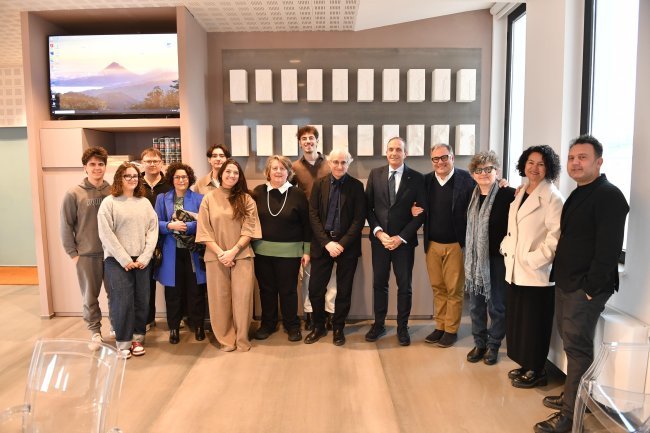
April 1 - May 3, 2026. Exhibition "Mediterranean Architecture and Design for Gianni Versace" at the National Archaeological Museum of Reggio Calabria.

As part of the consolidated synergy between the institutional missions of the Università Mediterranea di Reggio Calabria and the National Archaeological Museum of Reggio Calabria, Rector Giuseppe Zimbalatti and Director Fabrizio Sudano announce with mutual satisfaction the inauguration of the exhibition "Mediterranee. Architecture and Design for Gianni Versace ," curated by the Università Mediterranea's Department of Architecture and Design (dAeD). The exhibition will be held from April 1 to May 3, 2026, in Piazza Orsi, the Museum's internal courtyard, with free access to the public.
With this initiative, the Università Mediterranea di Reggio Calabria, and through it the dAeD, is contributing to the exhibition program "Gianni Versace. Terra Mater. Magna Graecia Roots Tribute," staged at the Museum and curated by Sabina Albano and Fabrizio Sudano himself. This project directly involves students from its three programs: the single-cycle master's program in Architecture, the bachelor's program in Design, and the master's program in Design for Mediterranean Cultures. Product | Space | Communication, under the supervision of the scientific and curatorial committee composed of Marinella Arena, Francesco Armato, Alessandra Barresi, Nino Sulfaro, and Marina Tornatora, and coordinated by Tommaso Manfredi and Consuelo Nava, director of the dAeD.
Following the evolution of Gianni Versace's Mediterranean vision, the young architecture and design students at dAeD reinterpret his cultural models and contexts according to the broadest and most complementary meaning of their respective theoretical and design disciplines, engaging with the architectural space and the vast archaeological heritage of the Museum, understood as the place that more than any other reflects his personal conception and definition of the past as a "path to the future."
Thus, the evocative installation in Piazza Orsi, in the form of a parade of figurative totems arranged on a geometric decomposition of the great designer's inspiring "Greek" motif, evokes and crystallizes his iconic artistic imagery through the visual and conceptual interpenetration of his creations and the museum collections, in the context of the immanent coexistence of his portrait and the statues of the Riace Bronzes in the background.
The students' contemporary reinterpretation of Versace's creative imagery is also reflected in the video mapping project on the Museum's main façade, which, for the duration of the exhibition, will serve as a digital backdrop in Piazza De Nava each evening for a visual narrative exploring the relationship between architecture and design, past and future.
Rector Zimbalatti and Director Sudano, applauding the initiative of the dAeD department, highlighted its high symbolic value.
In particular, Rector Zimbalatti states that " the Mediterranee exhibition project, implemented by dAeD students, is part of the University of Reggio's ongoing promotion and enhancement efforts for its local area. This area boasts extraordinary resources and potential, of which Reggio and the Strait of Messina are the epicenter, and the Università Mediterranea is the primary interpreter and promoter for younger generations, for whom it presents itself as a valuable educational and scientific resource based on virtuous planning and the valorization of its many areas of excellence ."
In this sense, director Sudano reiterates that “ the National Archaeological Museum of Reggio Calabria confirms itself as a place open to experimentation and dialogue between disciplines ”, and that “ the spaces, architecture and collections of the Museum become active tools for young designers, helping to create an ongoing dialogue between memory, creativity and contemporaneity ”.
Finally, as coordinators Manfredi and Nava underline, “ the dAeD students' tribute to Versace aims to restore, through a genuinely interdisciplinary approach, a contemporary perception of their common Mediterranean roots, in keeping with the department's mission in teaching, research and the valorization of the cultural, productive and socio-economic context ”.