The well-being and quality of life of students represents a concrete commitment of the Mediterranea
The well-being and quality of life of students is an increasingly concrete commitment for the Università degli Studi Mediterranea . The University of Reggio Calabria renews its support for young people and the challenges they may face in their education, in an important scientific discussion that focused on risky behaviors and protective factors, from a psychosocial and developmental perspective.
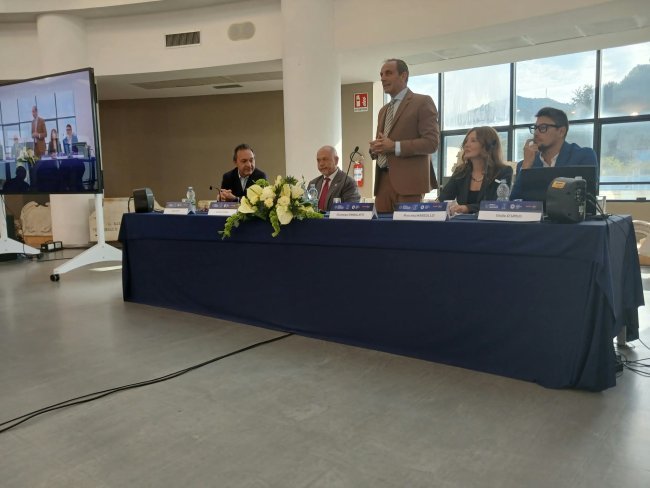
Professor Giuseppe Zimbalatti, rector of the Università Mediterranea di Reggio Calabria, welcomed the participants to the Atelier—attended, among others, by the rector of the University of Catanzaro, Giovanni Cuda, the CRUI delegate for psychological counseling. "We are pleased to say that the Mediterranea is creating the conditions to limit the hardships faced by our young people, and this program is growing rapidly," Zimbalatti began, thanking Rossella Marzullo, the delegate for Orientation; Giulio D'Urso, the entire Orientation department; and the ACE association (Calabrian Association of Hepatology - ACE Solidarity Medicine ETS), with its specialists providing student support within the University. "We are planning new student support structures," Zimbalatti announced.
Rector Giovanni Cuda provided a significant piece of information: students' strong demand for help and a listening ear, a sentiment likely heightened during the grim months of the pandemic. "This discontent can manifest itself insidiously and lowers the quality of our students. Fortunately, today," Cuda observed, "compared to the past, the level of sensitivity has been raised, and the fact that the psychological counseling service is operating at full capacity indicates the existence of the problem but also the effective response coming from the universities."
For the General Director of Mediterranea, Pietro Foti , "the attention, by no means taken for granted, dedicated to young people, represents one of the most beautiful pages of the University of Reggio".
According to Rossella Marzullo, Vice Rector for Orientation, "early detection of distress and risky behavior is a precise ethical and educational duty. It is precisely from this awareness and an integrated vision of supporting the student community that the Proben project was born, of which I am honored to be the scientific director. Thanks to this initiative, our University has been able to concretely activate and consolidate the counseling service, a safe space for listening and growth—also led by our psychologists Nadia Carbone and Maria Laura Falduto—designed to offer students first and foremost, but also the entire academic community, qualified support in addressing the difficulties and challenges of a complex society."
Drs. Nadia Carbone , Psychologist and Psychotherapist, and Maria Laura Falduto , Psychologist and Psychotherapist, have contributed significant and fruitful data to the Università Mediterranea Counseling service as part of the Proben project, which aims to promote psychophysical well-being, prevent psychological and emotional distress, and combat pathological addictions among students. From March 2026 to date, 350 psychological consultations and 93 new appointments have been conducted, and the demand trend is steadily increasing. Every consultation is hosted in comfortable and welcoming spaces where the careful selection of colors, furnishings, lighting, and greenery contribute to a calming and relaxing atmosphere, where the impact and perceived emotion shift from "seeing oneself as a problem" to "seeing oneself as a person." These elements are essential prerequisites for treatment. Furthermore, in addition to individual consultations, the service includes group initiatives, within an open and inclusive setting, aimed at promoting psychophysical well-being and implementing programs of inclusion and personal and emotional growth, as well as addressing risk factors for psychological distress.
The discussion was enriched by several expert presentations moderated by Professor Giulio D'Urso . Professor Gabrielle Coppola explored the topic of narcissism and its evolutionary origins, precursors, and the relationship between narcissism and self-esteem. Professor Christopher Osterhaus explained how theory of mind impacts children's development.
Professor Ugo Pace focused on risk in adolescence: identity, maladjustment, and protective factors. Professor Francesco Craig focused on the interactions between genetics and environment in relation to student well-being.
Professor Cristiano Inguglia addressed various topics: performance anxiety, analysis of risky behaviors such as disordered eating, substance use disorders, risky sexuality, and alcohol use.
It was a productive day of work that conveyed to young people the message of an increasingly inclusive University where no student is ever left behind.