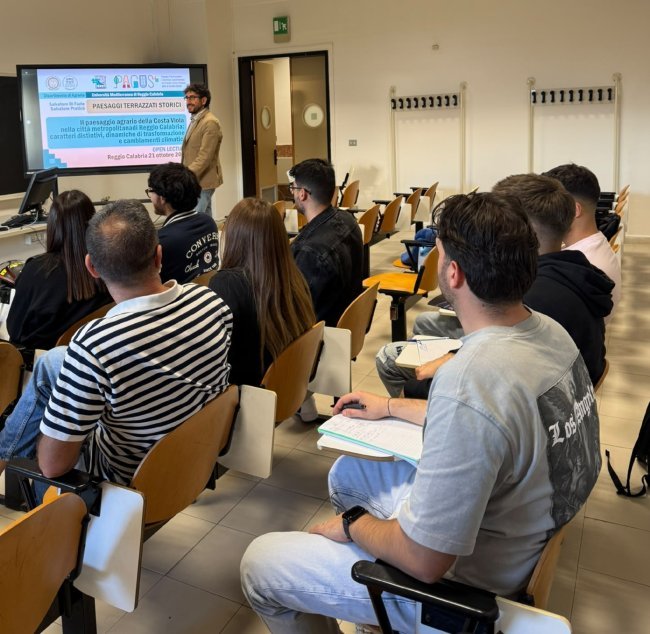
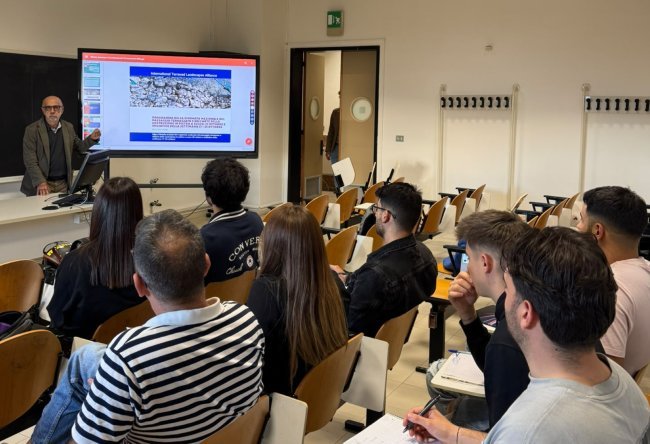
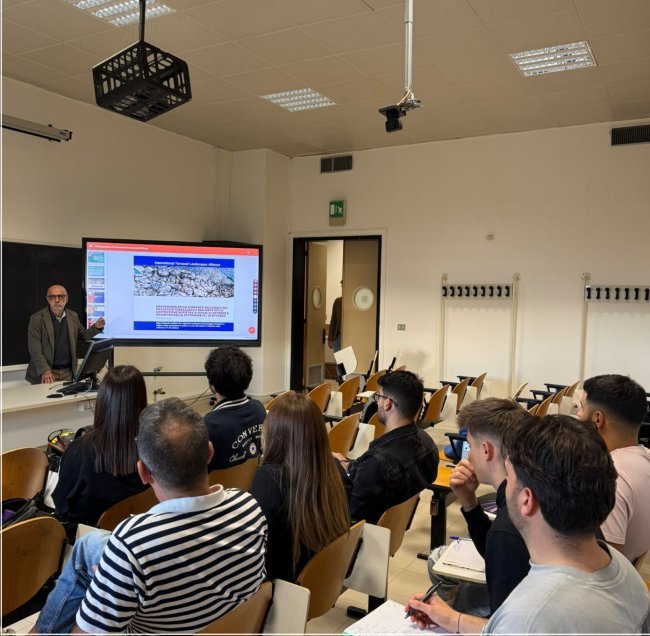
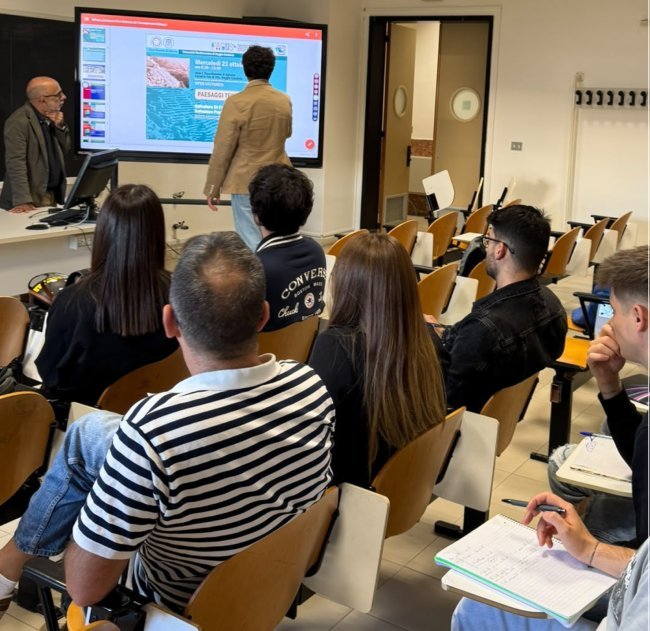
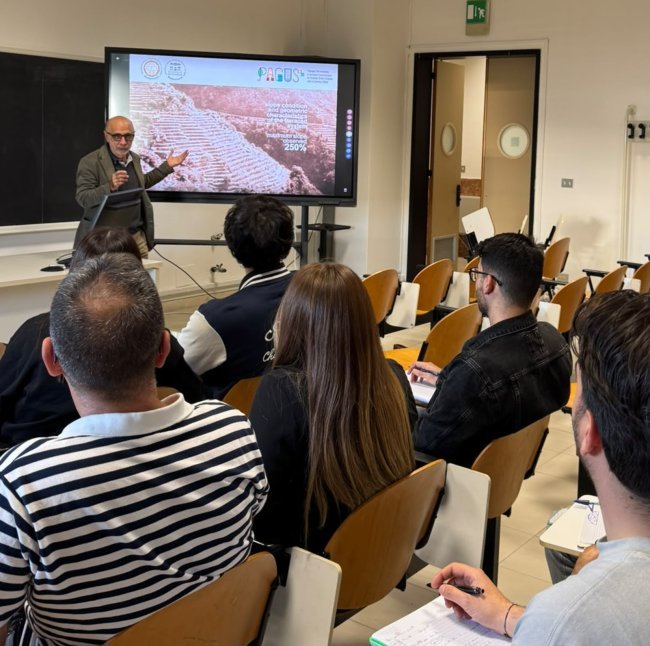
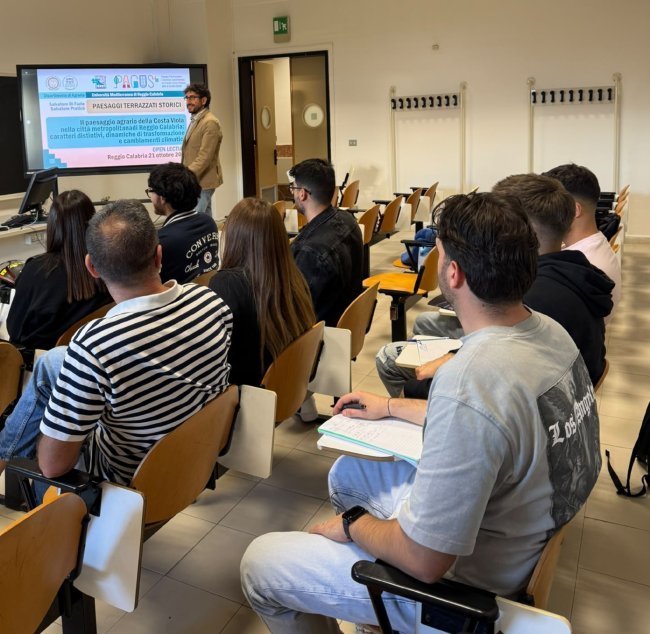
The historic terraced landscape of the Costa Viola in a seminar at the Department of Agriculture, as part of the ITLA initiatives and the PAGUS+ program.

On Wednesday, October 21, the Department of Agriculture at the Università Mediterranea di Reggio Calabria hosted an Open Lecture on Historic Terraced Landscapes, entitled "The Agricultural Landscape of the Costa Viola in the Metropolitan City of Reggio Calabria: Distinctive Characteristics, Dynamics of Transformation, and Climate Change." The seminar, held as part of the Integrated Course in "Analysis, Planning, and Infrastructure for the Rural Landscape," was led by Professors Salvatore Di Fazio and Salvatore Praticò.
With this initiative, the Department of Agriculture has joined the "National Day of Terraced Landscapes and the Art of Dry Stone Construction," organized by the Italian section of ITLA (International Terraced Landscape Alliance) ( LINK TO THE NATIONAL CALENDAR OF EVENTS ). The initiative is also part of the strategic project "PAGUS+ / Heritage Landscapes and Ecosystem Services in Large Urban Areas Ante el Cambio Global," led by the Andalusian Institute of Historical Heritage with the financial support of the Ministry of Science and Innovation (Spain), State Research and Development Program (PEICTI 2024-2027).
During the seminar, Professor Di Fazio highlighted the prevalent characteristics of the Costa Viola terraced landscape, highlighting the intrinsic and contextual factors that made it possible. It developed in an area prohibitive for viticulture, conquering slopes where terraces reached gradients of up to 250%. This was due to reasons beyond economic convenience. Indeed, as several economists have noted, terraced systems are the result of a social construction shared by the community, where the valorization of family labor and a cultural vision focused on the well-being of future generations and the preservation of the site have supported a vast transformation that could not have been justified by mere financial gain. Today, this landscape provides the population with various ecosystem services. In particular, in the face of extreme weather events linked to climate change, protection from hydrogeological risks becomes of paramount importance. From this perspective, the progressive abandonment of agricultural terraces in a historically fragile area is concerning, with significant consequences for land safety. Consider that in the Favazzina sub-zone, approximately 250 landslides and rockfalls of varying types and severity have been recorded over the past 75 years, causing serious damage to infrastructure and downstream settlements.
In his contribution, Professor Praticò presented a detailed territorial analysis of land use changes along the Costa Viola over the last 70 years, highlighting the progressive abandonment of the terraces for agricultural purposes. Compared to the over 800 hectares of agricultural terraces present in 1955, primarily dedicated to viticulture, in 2014 only 120 hectares of terraces remained active. The most dramatic decline occurred between 1955 and 1975, with a drastic halving of the utilized terraced area. Monitoring the area is now extremely important, as such consistent and prolonged abandonment can contribute to a worrying increase in hydrogeological risk in the area. The seminar, however, noted some encouraging countertrends: the ecotourism development of trails among the terraces, the promotion of wine production through the creation of virtuous networks between producers and processing companies, and various attempts to enhance the terraced landscape for tourism and culture. While in the past, agricultural reasons made terraced systems possible, contributing to the safety of the sites and historically appreciated by the many travelers who visited them, today it is precisely the ecosystem services they provide that can support the continuation of viticulture in those same places.
The presentations by Professors Praticò and Di Fazio were followed by a lively debate with contributions from students, researchers, and industry professionals. The importance of the ITLA national day (or rather, week) dedicated to terraced landscapes and the art of dry stone construction was reiterated. This year, several institutions across Italy participated in the event with a variety of initiatives (photography exhibitions, conferences and seminars, guided tours, field trips, etc.).