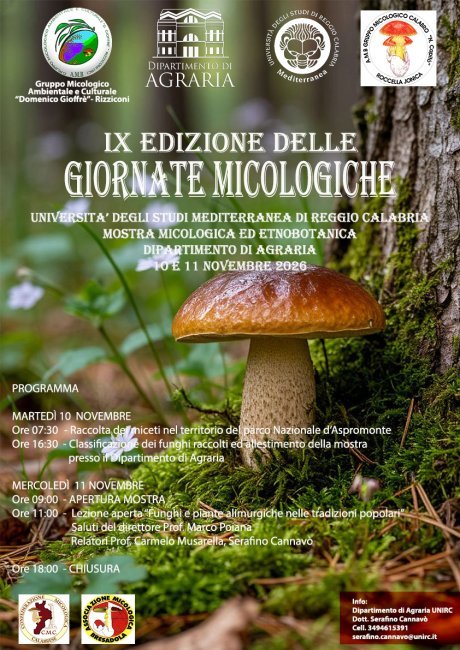
IX Edition of the Mycological Days 2026
The Department of Agriculture of the Università Mediterranea di Reggio Calabria and the “Domenico Gioffré” Mycological Group of Rizziconi, in collaboration with the “N. Capitò” Mycological Group of Roccella Jonica, are promoting the ninth edition of the “Mycological Days” , scheduled for November 10 and 11, 2026, at the Department of Agriculture.
The initiative, now well-established in the field of scientific dissemination and promotion of the area's natural heritage, represents an important opportunity for academics, industry experts, students, and mycology enthusiasts to meet.
The two days will be dedicated to understanding, researching, and studying the mushroom species characteristic of the Aspromonte region, with particular attention to biodiversity, ecosystem protection, and the promotion of sustainable and responsible harvesting practices.
New to this edition will be a space dedicated to alimurgic plants , that is, those wild plant species traditionally used in human nutrition. This in-depth study will explore the relationship between natural resources, popular traditions, and food culture, leveraging the knowledge passed down through the generations.
The initiative's goal is to raise awareness among students, citizens, and enthusiasts about the importance of properly recognizing mushroom and plant species, promoting responsible harvesting and consumption, while fully respecting the environment and food safety.
Tuesday, November 10 – Research and collection of mushroom species
The first day will be dedicated to a field trip to research, collect, and select mushroom specimens for the mycological exhibition.
The activity will be coordinated by staff from the Department of Agriculture and representatives of the "Domenico Gioffré" Mycological Group and will offer participants the opportunity to gain a deeper, hands-on understanding of the main fungal species and the natural environments in which they grow.
4:30 PM Classification of fungal species and exhibition setup by Prof. Carmelo Musarella and the mycologists of the two involved mycological groups.
At 4:30 pm , at the Department of Agriculture, the collected specimens will be classified and the mycological exhibition will be set up, curated by Prof. Carmelo M. Musarella and the mycologists of the two groups involved in the initiative.
University students and all interested parties may participate, upon reservation by emailing [email protected] .
Wednesday, November 11 – Mycological exhibition and open lecture
Starting at 9:00 am , the mycological exhibition will be inaugurated at the Department of Agriculture, with the specimens collected during the previous day on display.
Mycologists Serafino Cannavò and Giuseppe Liberti will guide visitors through the world of mushrooms, illustrating the distinctive characteristics of the different species, their role in ecosystems, and aspects related to safe identification and harvesting.
During the day, after the institutional greetings of Prof. Marco Poiana, Director of the Department of Agriculture , an open lesson will be held entitled:
“Mushrooms and Food Plants in Popular Traditions”
The meeting will see the participation of:
- Prof. Carmelo M. Musarella , Associate Professor of Environmental and Applied Botany at the Università Mediterranea di Reggio Calabria;
- Dr. Serafino Cannavò , mycologist and President of the “Domenico Gioffré” Mycological Group.
The lesson will offer an in-depth look at the scientific, cultural, and ethnobotanical value of mushrooms and edible wild plants, highlighting their use in local food traditions and the role of folk knowledge in the conservation and transmission of natural heritage.
The "Mycological Days 2026" thus confirms its role as an event dedicated to scientific dissemination, environmental education, and the valorization of the natural resources of the Aspromonte, fostering dialogue between university research, associations, and the local community.
Participation offers an opportunity to learn more about the area's extraordinary biodiversity and rediscover the connection between nature, science, and tradition.