Transhumance and the Podolica cow: a millennial heritage for the future of young people and Southern Italy.
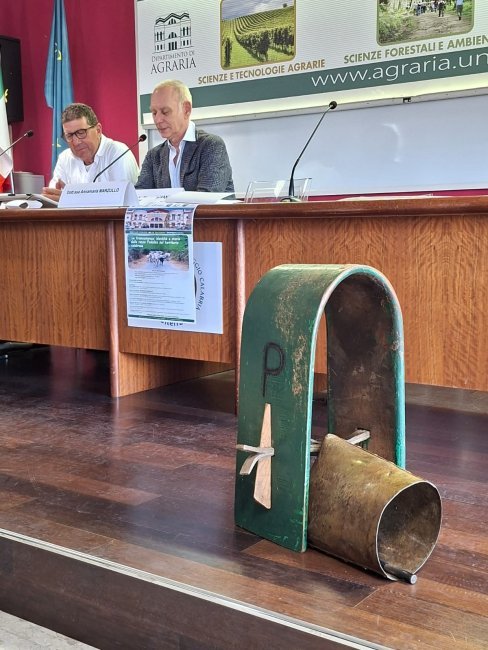
The preservation of the Podolica cattle breed and the age-old practice of transhumance were the focus of an important day of discussion, promoted by the Department of Agriculture of the Università Mediterranea di Reggio Calabria.
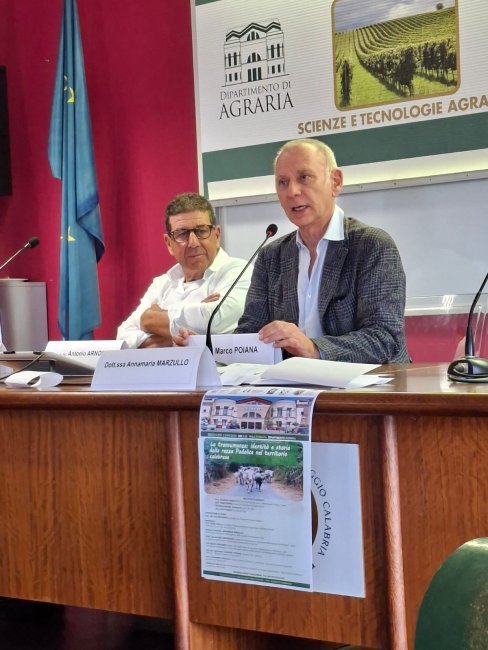
The proceedings were opened by Professor Marco Poiana , Director of the Department of Agriculture at the Università Mediterranea di Reggio Calabria. In his opening remarks and institutional greetings, the Director emphasized the Department's central importance in promoting scientific and cultural reflection on issues that directly impact the region's identity and development.
Professor Matteo Bognanno , Job Placement delegate and professor at the Department of Agriculture, served as moderator and coordinator of the conference, playing a key role in both the introduction and the summary and closing remarks. In his remarks, he highlighted the strategic connection between university education and career opportunities in the agri-food sector, drawing attention to the need to combine the preservation of historical traditions with new employment and development opportunities for young people. In his closing remarks, Professor Bognanno reiterated the importance of networking between universities in Southern Italy (Calabria, Molise, and Sicily), trade associations (ARA and AIA), and regional institutions to transform transhumance into a concrete socio-economic lever against the depopulation of inland areas.
The conference highlighted how this ancient pastoral practice still represents a strong cultural and territorial identity for Calabria and, more generally, for the inland areas of Southern Italy. Transhumance is not only a testament to rural tradition, but also represents a system of land management capable of intertwining livestock, environmental, economic, and social aspects.
In this context, the Podolica breed takes on particular importance , as it is closely linked to extensive farming systems. Its valorization can contribute to the protection of biodiversity, the conservation of rural landscapes and the safeguarding of a heritage of knowledge and practices handed down over time.
Of particular interest was the interregional dimension of the discussion, which allowed us to connect the Calabrian experience with other realities in Southern Italy historically linked to pastoralism and transhumance.
The University of Molise , represented by Professor Fabio Pilla , made a significant contribution . With his presentation "Transhumance 2.0: Not Just Livestock," he proposed a reading of transhumance that transcends its strictly productive and livestock-related dimensions. The presentation helped frame transhumance as a complex phenomenon in which livestock farming, territory, tradition, and local development are closely interconnected.
From the analysis of the management of Podolica cattle herds that practice transhumance in Sila, conducted by Dr. Annamaria Marzullo , the ability of transhumance to act as an ecological, economic, and cultural bridge between mountainous areas (such as the Sila plateau) and the coastal and hilly maritime zones of the Ionian coast of the Calabria region clearly emerged.
The dialogue between different territories has allowed us to identify common elements and local specificities, encouraging the exchange of knowledge and good practices. In this perspective, the interventions of the professors of the Department of Agriculture, Food and Environment of the University of Catania (Di3A) have been significant , allowing us to address the issue of
transhumance according to a perspective strongly oriented towards the valorization of the territory, extensive livestock systems and agri-food production .
Professor Salvatore Bordonaro 's speech , dedicated to "Transhumance in Sicily: from tradition to promotion of territories ," focused on the possibility of transforming a pastoral practice deeply rooted in Sicilian history into a tool for territorial valorization and the identity of local communities, highlighting the potential of transhumance also in relation to the promotion of inland areas and the construction of sustainable development paths.
This contribution was accompanied by that of Prof. Guido Mangione , with the speech “From pasture to cheese: the role of extensive systems in the quality and identity of dairy production” , thanks to which the direct relationship between breeding system, grazing feed and the quality of dairy production was explored in depth .
The presentation by the Director of ARA Calabria , Dr. Citraro, sharing the results of the TRACCE project, added a perspective directly tied to the local area and the farming communities , completing the framework that emerged from the scientific presentations by the universities. This led to a vision of transhumance as a heritage to be studied, documented, protected, and promoted, through increasingly close collaboration between research, institutions, and the production world. This was also thanks to the documentary film dedicated to transhumance, produced with the direct involvement of the farmers, in collaboration with the Calabria Region .
The screening provided a concrete and authentic perspective on the phenomenon, giving voice to those who live and practice livestock farming and transhumance on a daily basis. The value of the documentary lies precisely in its ability to document not only the technical aspects of pastoral activity, but also the human, cultural, and identity-based relationships that bind farmers to their animals and their territories .